An Italian homecoming and leaving my comfort zone
festival delle storie, ATINA, ITALY

I have recently returned from presenting Broken Madonna at Festival delle Storie, a well-respected annual literary festival, in Atina, Italy – the place where Broken Madonna is set. It was a truly overwhelming and life-affirming experience to share the novel with people who knew the setting and the interplay between the role of women, the Catholic Church, societal expectations, post WW2 trauma, motherhood and poverty. The setting in the vineyard of La Ferriera was very special and the warm reception from the large audience of around 200 people gave me a profound sense of Broken Madonna being among her people.

La Ferriera, Atina
What I hadn’t reckoned on was the personal impact. Before the interview there had been a string of reconnections to be made, from old friends to family who I’d not seen in many, many years. New connections too, eager to hear about the writer from England who had wanted to capture their valley in words. The welcome was effusive. In this part of Italy where so many like my parents have emigrated over the years, there is affection for those who return, who feel the draw of the beautiful mountains and valleys of their ancestors, their roots pulling them back. Why hadn’t I returned sooner? Until I was 18 when my Nonna died, I had spent many long hot summers in Atina. There are practical reasons I could reel out, but reality is much more complex. I’m not entirely sure I can articulate the factors, but they are wrapped up in feelings of guilt and shame which lie at the heart of emigration. I suspect my parents knew these feelings only too well, even if they chose never to talk about them. Maybe I picked it up in their behaviour, their day-to-day attitudes. By seeking a better life elsewhere, part of you has to turn your back on what you have known, what you had to leave behind. A distance is created. Now you’re no longer part of where you came from, with the prevailing mindset and way of doing things. Language and cultural differences keep you at bay in your new home country. An outsider where you came from, an outsider where you chose to make your new life. How far does this reach and impact subsequent generations? I’ve always known there was part of me trying to figure out issues around identity and belonging in terms of what I’d chosen to write, sitting beneath the conscious surface of my novel. As a girl born in England and raised here in the ‘70s and ‘80s, to older barely literate Italian parents who had been born into the rural poverty of the 1920s, what did I share with them? Certainly not attitudes towards women and education. Setting Broken Madonna in the Italy of the late ‘40s and England in the ‘90s wasn’t a deliberate decision, more the subjects I wanted to explore, and I had intimate knowledge of both. Yet feelings of inadequacy came back in full force when faced with talking to an Italian audience about Broken Madonna. Speaking Italian? I’d become a linguist and studied French and German at university but had turned my back on my parent’s dialect at a young age, responding to them in English. I’d never learnt grammatically correct Italian, with its formality and myriad of tenses, and wasn’t sure when I spoke Italian, what was coming out of my mouth. A long forgotten and outdated dialect which would open me up to ridicule? No wonder I wasn’t comfortable speaking Italian. Then there were questions that drilled right into my core. Why was I the one writing about Italy in the ‘40s when I hadn’t even lived there? What gave me the right to write this story? It was time to own it, there was nothing else for it. Preparation helped but most of it all, it was returning to Atina a couple of months before the festival, speaking to people and finding that they didn’t mock my English accent, they were gracious enough to praise my Italian. I was being welcomed back, finding my place. One of their own.

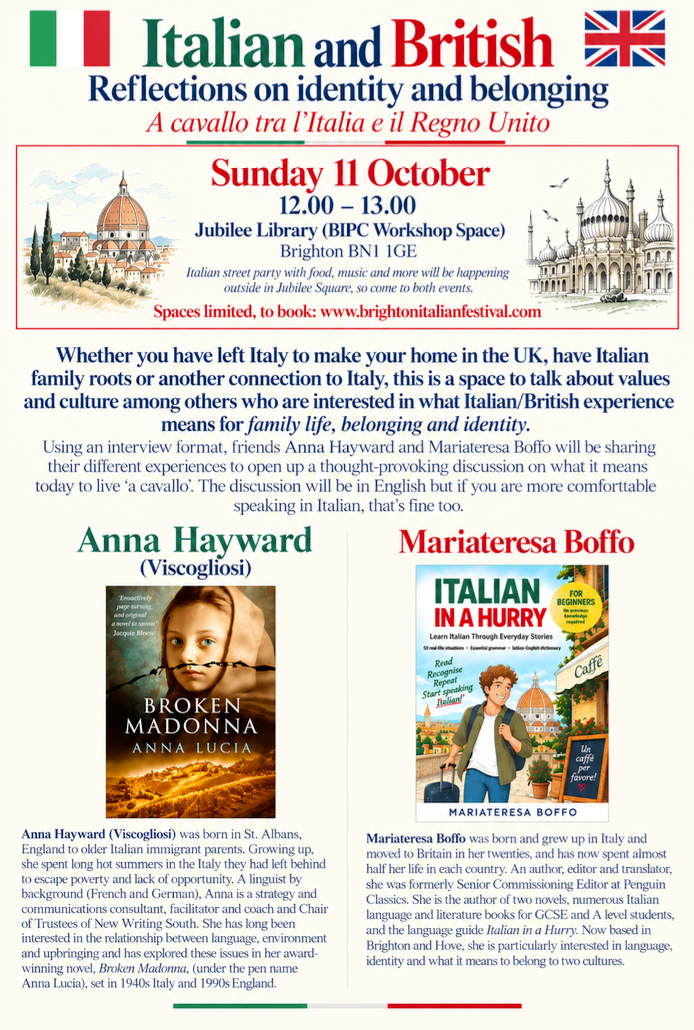
I’d imagined speaking at Festival delle Storie would be about finding a publisher for the Italian translation of Broken Madonna, which is now complete, thanks to Mariateresa Boffo. The interview was in Italian, I read the prologue in Italian (video here). It was a terrific success from the reaction both while I was speaking and after, when many just came to shake my hand and told me how I had touched them. Most of all, it was a humbling, profound homecoming for Broken Madonna and for me. I’m not sure what my parents would have made of it, proud I hope, but accompanied by my daughter Nina, we reflected on how a fictional story reaches into the past and threads into the future too. If anyone ever wants to know why you spend so long writing a novel and refining and reworking it, I believe I found my answer.


Comments